ANISO
Orienting 3D-printing toolpaths to create new reflections.
Project goal
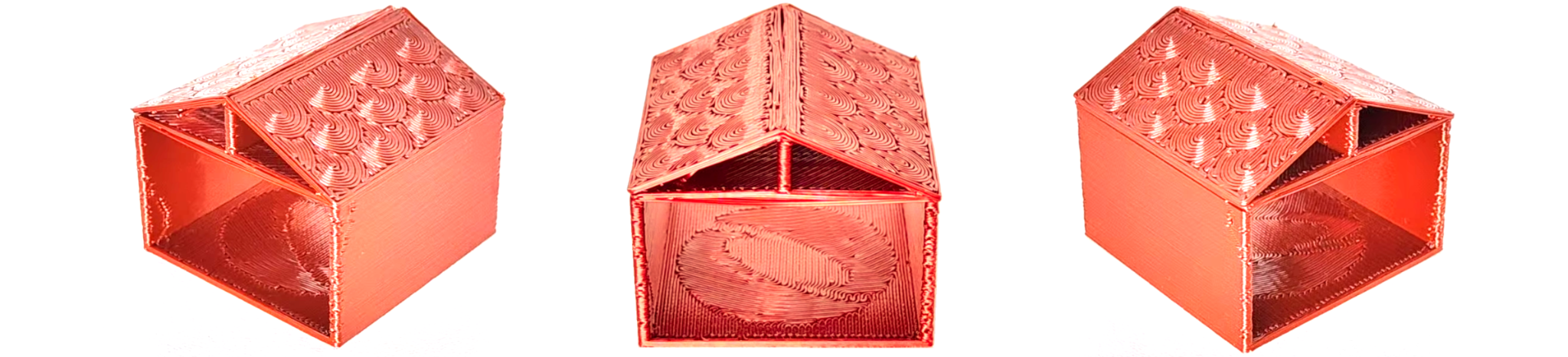
ANISO develops digital tools and manufacturing processes to control the local orientation of material deposition in 3D printing. This control makes it possible to create customized anisotropic appearances—direction-dependent reflections similar to brushed metal—on planar surfaces and 3D objects using a single material, without paint or added chemical treatments.
The scientific challenge is to go from a desired spatially varying orientation to a dense, regular, continuous and manufacturable trajectory. The project combines computational geometry, computer graphics and digital fabrication. It targets fused filament fabrication (FFF) and surface brushing; current results primarily focus on non-planar and multi-axis FFF.
Résumé en français
ANISO développe des outils numériques et des procédés de fabrication permettant de contrôler localement l’orientation du dépôt de matière en impression 3D. Ce contrôle permet de créer, avec un matériau unique, des apparences anisotropes personnalisées — comparables aux reflets d’un métal brossé — sur des surfaces planes ou des objets 3D, sans peinture ni traitement chimique ajouté.
Le défi consiste à transformer une orientation souhaitée, variable dans l’espace, en trajectoires denses, régulières, continues et effectivement fabricables. Le projet combine géométrie numérique, informatique graphique et fabrication numérique.
From orientation fields to fabricated objects
1. Design orientations
Represent the desired local anisotropy as direction fields on surfaces or inside volumes.
2. Generate filling curves
Construct field-aligned curves with controlled spacing, robust stitching and scalability to complex geometries.
3. Make them manufacturable
Generate non-planar, continuous toolpaths while controlling bead geometry, nozzle accessibility and collisions.
Publications and results
The project has produced a sequence of complementary results, from real-time rendering of anisotropic materials to geometric algorithms, machine kinematics and experimentally validated toolpaths.
Scientific foundation
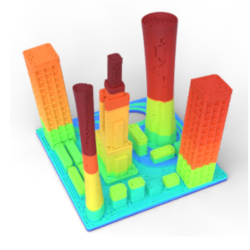
ANISO builds on our 2023 SIGGRAPH work, Orientable Dense Cyclic Infill for Anisotropic Appearance Fabrication, which demonstrated that orienting continuous FFF deposition paths can directly control anisotropic reflections on printed surfaces. ANISO extends this idea from planar patterns toward general 3D surfaces, volumes, non-planar toolpaths and fabrication-aware algorithms.
Open-source software and prototypes
-
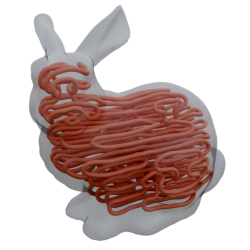
Wave-Guided Field-Aligned Volume-Filling Curves: code
-
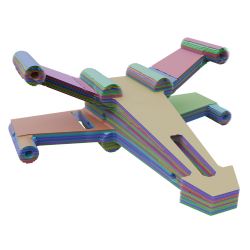
AtomSlicer: code · replicability stamp
-
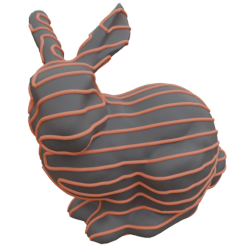
Field-Aligned Surface-Filling Curve via Implicit Stitching: code · replicability stamp
-
Towards Accessible Non-Planar FFF Using Triple Z-Axis Kinematics: code · CAD / machine design
-
Atomizer: code · replicability stamp
-
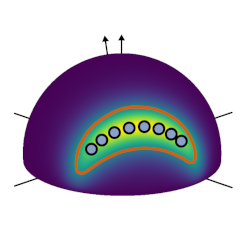
Anisotropic Specular Image-Based Lighting Based on BRDF Major Axis Sampling: code · replicability stamp
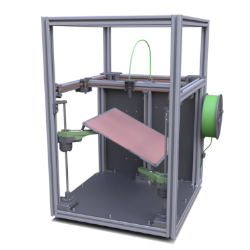
A dedicated triple-Z-axis FFF prototype was also developed from a desktop printer. By independently actuating the three Z axes, the print bed can tilt to execute non-planar trajectories with limited hardware modifications, providing an accessible platform for experimental validation.
Videos and demonstrations
The following presentation gives a broad introduction to Atomizer, why conventional slicing is restrictive, and how the project approaches non-planar toolpath generation.
-
Wave-Guided Field-Aligned Volume-Filling Curves: presentation · supplementary video
-
AtomSlicer: supplementary video
-
Field-Aligned Surface-Filling Curve via Implicit Stitching: supplementary video
-
Towards Accessible Non-Planar FFF Using Triple Z-Axis Kinematics: presentation · supplementary video
-
Atomizer: presentation · supplementary video
-
Anisotropic Specular Image-Based Lighting Based on BRDF Major Axis Sampling: supplementary video
Gallery
AtomSlicer: anisotropic appearance on a non-planar printed object.
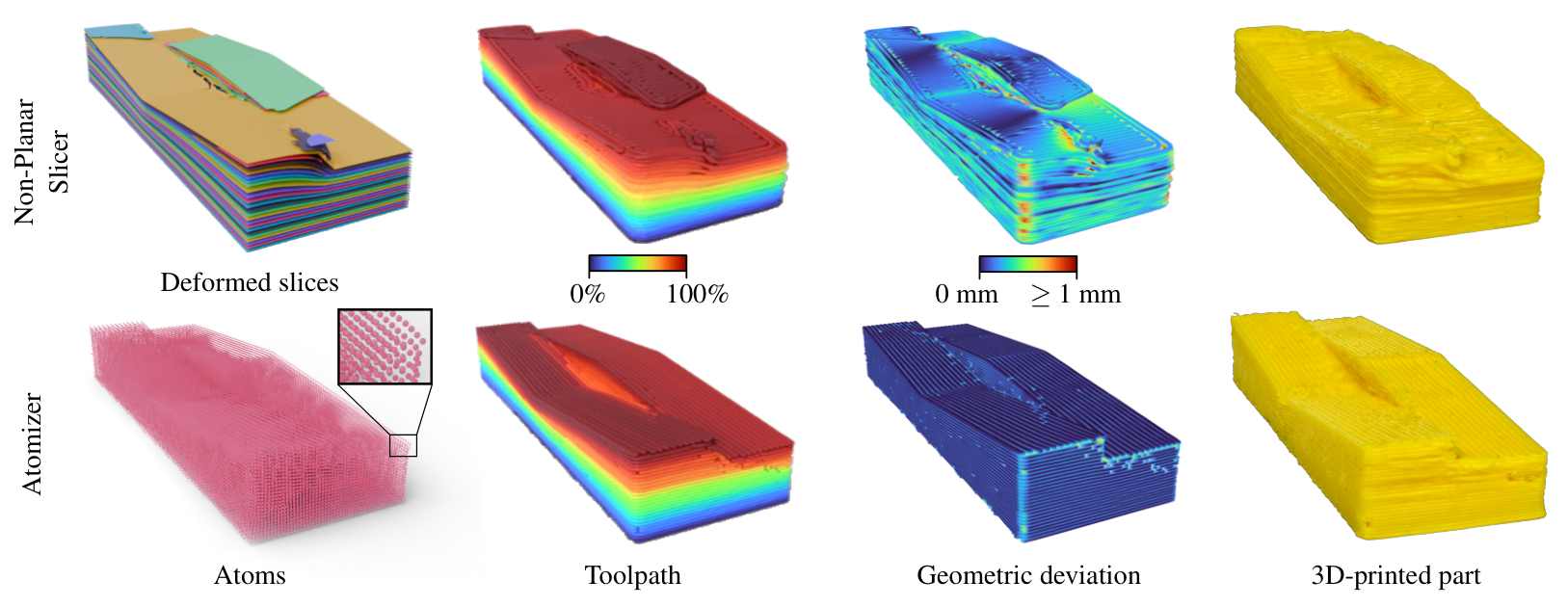
Atomizer: toolpath generation beyond conventional layer-based slicing.
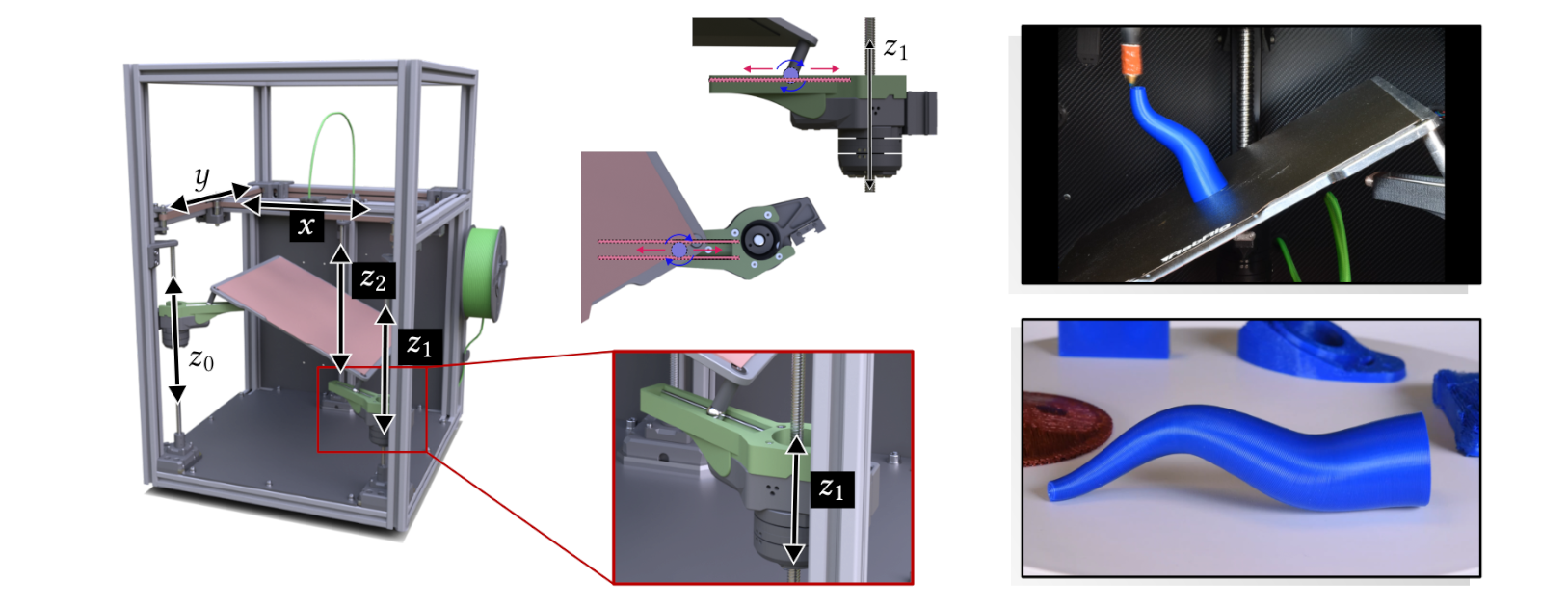
Triple-Z kinematics: an accessible platform for non-planar FFF.
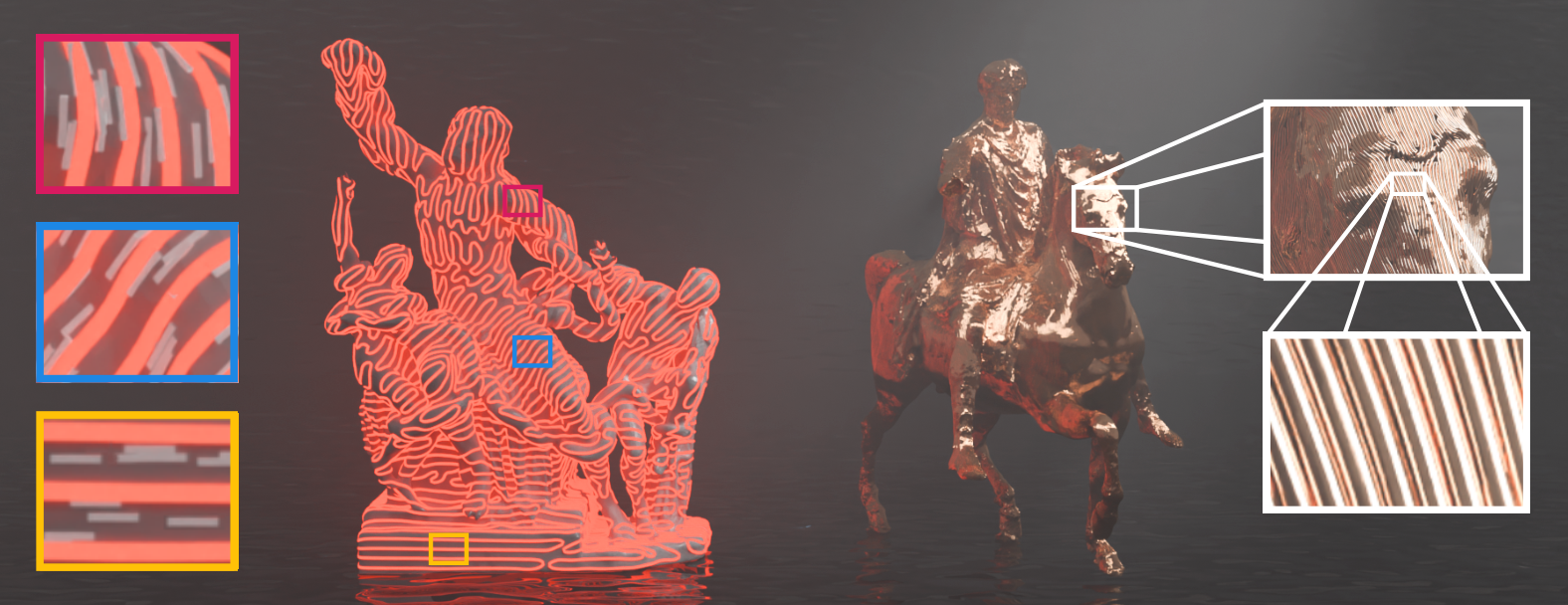
Surface-filling curves: robust field-aligned trajectories on general surfaces.
People
The project is carried out in the MFX team at LORIA, with Université de Lorraine, CNRS and Inria, Nancy, France.
Funding
ANISO is funded by the French National Research Agency (ANR) through the JCJC — Young Researchers instrument.
- Project: Anisotropic Appearance Fabrication With High-Resolution and Spatially Varying Orientations
- ANR reference: ANR-24-CE10-6403
- Period: October 2024 – October 2028
- Call: Industry 4.0: People, Organization, Technologies
The PhD work is also co-funded by the Région Grand Est.
Contact
Interested in the project, its software, or potential collaborations? Contact Xavier Chermain at xavier.chermain@inria.fr.